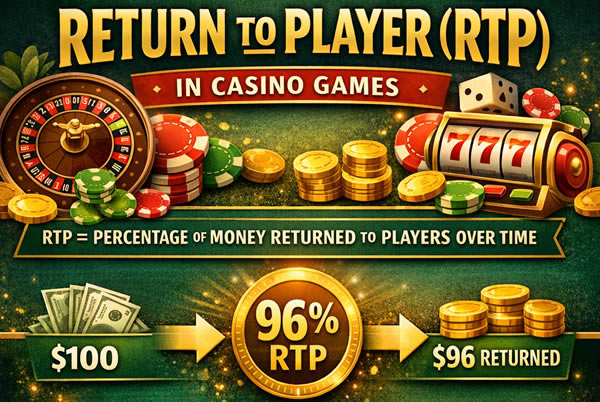
Return to Player (RTP) is one of the most important concepts in online casino gaming. It represents the percentage of wagered money that a casino game pays back to players over time. Understanding RTP can help players choose better games, manage their bankroll more effectively, and set realistic expectations when gambling online.
In simple terms, RTP indicates how much of the total bets placed on a game are theoretically returned as winnings in the long run. While it does not guarantee short-term results, it provides a statistical measure of the game’s payout potential.
What Is RTP in Online Casino Games?
Return to Player (RTP) is expressed as a percentage and reflects a casino game’s long-term payout ratio. The game makers calculate it. They base it on millions of simulated rounds or real-money gaming outcomes.
For example:
- A slot with 96% RTP returns approximately $96 for every $100 wagered over time.
- The remaining 4% represents the casino’s house edge.
This does not mean every player will lose 4%. Instead, RTP is calculated over very large sample sizes, meaning individual sessions can produce much higher wins or bigger losses.
How RTP Is Calculated
The RTP of a casino game is determined using a mathematical formula:
RTP = (Total Player Winnings ÷ Total Amount Wagered) × 100
Example:
- Total wagers: $10,000,000
- Total winnings returned: $9,600,000
RTP = 96%
Game developers design the RTP by adjusting:
- Paytables
- Winning combinations
- Bonus features
- Jackpot probabilities
Before release, independent auditing agencies typically test and certify games to ensure the RTP is accurate and fair.
The Role of Random Number Generators (RNG)
Casino games—especially online slots and digital table games—use a Random Number Generator (RNG) to determine outcomes.
An RNG is a sophisticated algorithm that continuously generates random numbers every millisecond. When a player spins a slot or places a bet, the RNG instantly determines the result.
This system ensures that:
- Every round is independent and unpredictable
- Past results do not influence future outcomes
- The game follows the probabilities used to calculate the RTP
Because of RNG technology, RTP remains a statistical expectation, not a guarantee for individual players.
Why RTP Is Important for Casino Players
Understanding RTP can help players make smarter gambling decisions when choosing between different casino games.
1. Better Long-Term Value
Games with higher RTP percentages statistically return more money to players over time.
2. Easier Game Comparison
This lets players compare slots and table games objectively before playing.
3. Improved Bankroll Management
High-RTP games generally let players play longer on the same budget.
4. More Transparent Casino Experience
Reputable online casinos display Return to Player values to maintain transparency and trust.
Average RTP in Different Casino Games
Return to Player varies by game type.
Online Slots RTP
Most online slot machines have RTP values between:
- 94% – 96% (average slots)
- 96% – 98% (high RTP slots)
- Some premium slots exceed 98% RTP
Slots with high RTP are often preferred by players looking to maximize potential returns.
High RTP Slot Games to Try
Table Game RTP
Table games usually offer higher RTP percentages than slot machines, especially when played using optimal strategy.
Typical RTP values include:
Because many table games involve player decisions, the actual Return to Player may depend on strategy and experience.
RTP vs House Edge
RTP is directly related to the house edge, which represents the casino’s built-in advantage.
The formula is simple:
House Edge = 100% − RTP
Examples:
| RTP | House Edge |
|---|---|
| 96% | 4% |
| 97% | 3% |
| 98% | 2% |
A lower house edge means better long-term odds for players.
RTP vs Volatility in Slots
While RTP shows how much a game pays back, it does not describe how often players win. Volatility (also called variance) determines that.
Low Volatility Slots
- Frequent small wins
- Lower risk
- Longer gameplay sessions
Low Volatility Slots Explained
High Volatility Slots
- Less frequent payouts
- Larger potential wins
- Higher risk but bigger jackpots
High Volatility Slots Explained
Two slots may both have 96% RTP, but their volatility can create very different gameplay experiences.
RTP in Online vs. Land-Based Casinos
Online casinos often offer higher RTP percentages than physical casinos.
This happens because online operators have:
- Lower operating costs
- Larger game libraries
- More competition between platforms
As a result, many online slots feature RTP values above 96%, while land-based machines often range from 85% to 92%, depending on regulations and location.
Common Myths
There are several misconceptions about RTP that many players believe.
Myth: A slot is “due” for a payout
Casino games use Random Number Generators (RNG), meaning every spin is independent and completely random.
Myth: High RTP guarantees profits
Even with a high Return to Player, the casino always maintains a statistical advantage.
Myth: RTP affects short sessions
RTP only reflects long-term averages across millions of rounds.
Tips for Choosing High RTP Casino Games
Players looking to maximize their chances of winning can follow a few simple strategies:
- Choose slots with 96% RTP or higher
- Look for high RTP table games like blackjack
- Check the game information or paytable
- Play at licensed online casinos
- Balance RTP with volatility and bonus features
Final Thoughts
Return to Player (RTP) is a fundamental concept in casino gaming that helps players understand a game’s expected payout over time. By examining RTP values, players can compare games, evaluate potential value, and manage their bankroll more effectively.
However, RTP should never be considered in isolation. Factors such as volatility, betting limits, game mechanics, and personal risk tolerance also play an important role in the overall gaming experience.
For players looking to maximize value and make informed decisions, choosing games with higher Return to Player and suitable volatility levels is often the best strategy for enjoying casino gameplay responsibly.
 James Buttler, the author, possesses four decades of casino experience gained through playing in brick-and-mortar establishments. Additionally, he has dedicated 20 years to blogging and content creation within the iGaming and various other industries.